
library(knitr)
library(collision)
library(ggplot2)

# for easy summarising and joins
library(data.table)
#>
#> Attaching package: 'data.table'
#> The following object is masked from 'package:base':
#>
#>     %notin%

# for distance modelling
library(Distance)
#> Loading required package: mrds
#> This is mrds 3.0.1
#> Built: R 4.6.0; ; 2026-04-24 22:38:47 UTC; unix
#>
#> Attaching package: 'Distance'
#> The following object is masked from 'package:mrds':
#>
#>     create.bins
Deterministic Example
This is a good example to start with. It models a (fictional) site with 2 proposed turbines, all of the same model, and a (fictional) point count survey of Wedge-tailed Eagle. For this example we assume flight density is constant across the site.
We are going to calculate a simple deterministic model output here. For a stochastic output see the other examples.
Define inputs
Turbine model
Step one is to set up a turbine - here’s an example based on a Vestas
90, set up using the define_turbine function:
v90_single <- define_turbine(
  model_id = "Vesta V90",
  blade_length = 44,
  blade_thickness_narrow = 0.07,
  blade_thickness_wide = 2.6,
  d_base = 4.15,
  d_rotormin = 3.55,
  d_top = 2.55,
  hh = 65,
  max_chord = 3.51,
  min_chord = 0.39,
  max_nac_h = 4.05,
  max_nac_l = 13.25,
  max_width_nacelle = 3.6,
  rpm = 16.1,
  rotor_diam = NULL,
  tilt_deg = 6,
  prop_operational = 0.98
)

## Note
##    max height is defined as hh + rotor_diam/2
##    min height is defined as hh - rotor_diam/2
## so these parameters are not needed separately
Bird species
Now we need a bird (see define_bird)
wte <- define_bird(
  species = "Wedge-tailed Eagle",
  bird_length = 0.945,
  bird_speed = 17,
  prop_day = 0.5,
  prop_year = 1,
  avoidance_dynamic = 0.90,
  avoidance_static = 0.9999
)
Turbine layout
The basic template for the model outputs is a data.frame
of turbine inputs. These can be read in from a csv, or you can set them
up with a few basic pieces of information and the turbine definition
above.
For each turbine we need a turbine ID, and a location. It is good
practice to include a model_id that matches the model
turbine you have defined for use.
df_turbines <- data.frame(
  turbine_id = c("T01", "T02"),
  model_id = c("Vesta V90"),
  lat = c(-32.512, -32.521),
  lon = c(143.441, 143.442)
)
Survey data
The package observations dataset:
summary(df_obs)
#>     distance           size              type         height
#>  Min.   : 136.0   Min.   :1.000   Length   :120   Min.   :  2.00
#>  1st Qu.: 519.5   1st Qu.:1.000   N.unique :  1   1st Qu.: 33.50
#>  Median : 818.5   Median :1.000   N.blank  :  0   Median : 77.00
#>  Mean   : 852.6   Mean   :1.283   Min.nchar:  6   Mean   : 97.63
#>  3rd Qu.:1134.2   3rd Qu.:2.000   Max.nchar:  6   3rd Qu.:122.00
#>  Max.   :2334.0   Max.   :2.000                   Max.   :518.00
#>    survey_id          object
#>  Min.   :  2.00   Min.   :  1.00
#>  1st Qu.: 27.25   1st Qu.: 30.75
#>  Median : 54.50   Median : 60.50
#>  Mean   : 53.56   Mean   : 60.50
#>  3rd Qu.: 77.25   3rd Qu.: 90.25
#>  Max.   :100.00   Max.   :120.00
is a dataset of 120 observations from 100 point count surveys,
including the count (size) of raptors (and associated
distance at first observation (distance)).
And the package survey dataset:
summary(df_survey)
#>    survey_id      survey_duration    survey_type
#>  Min.   :  1.00   Min.   :45      Length   :100
#>  1st Qu.: 25.75   1st Qu.:45      N.unique :  1
#>  Median : 50.50   Median :45      N.blank  :  0
#>  Mean   : 50.50   Mean   :45      Min.nchar:  5
#>  3rd Qu.: 75.25   3rd Qu.:45      Max.nchar:  5
#>  Max.   :100.00   Max.   :45
is a dataset of the metadata for the 100 point count surveys, including the duration of each survey.
It’s very important that the field data include any surveys with no sightings as well as positive detections.
Between the two of them these tables must include:
- Distance to the bird at first sighting in metres. If line-transect sampling, this is usually the perpendicular (right-angle) distance from the transect line.
- Duration of each survey in minutes
- Count of individuals in each observation (
size).
We fit a detection function to the distance observations and extract the effective detection radius (EDR). The effective detection radius is the radius of a circle, such that if 100% of flights were observed within this circle, the expected number of flights detected is the same as for the actual survey (which has decaying detectability with distance).
- NOTE Please see Distance and the references therein for a complete primer on doing and interpreting Distance analysis.
- NOTE This same process works for the Effective Strip half Width or ESW for line transects. The ESW is the effective perpendicular distance an observer can see out one side of a line transect).
ds_model <- ds(
  data = df_obs,
  truncation = max(df_obs$distance, na.rm=TRUE),
  transect = "point",
  formula = ~1,
  key = "hr",
  dht_group = TRUE,
  nadj = 0
  )
#> Fitting hazard-rate key function
#> AIC= 1790.852
#> No survey area information supplied, only estimating detection function.

plot(ds_model, pdf=TRUE)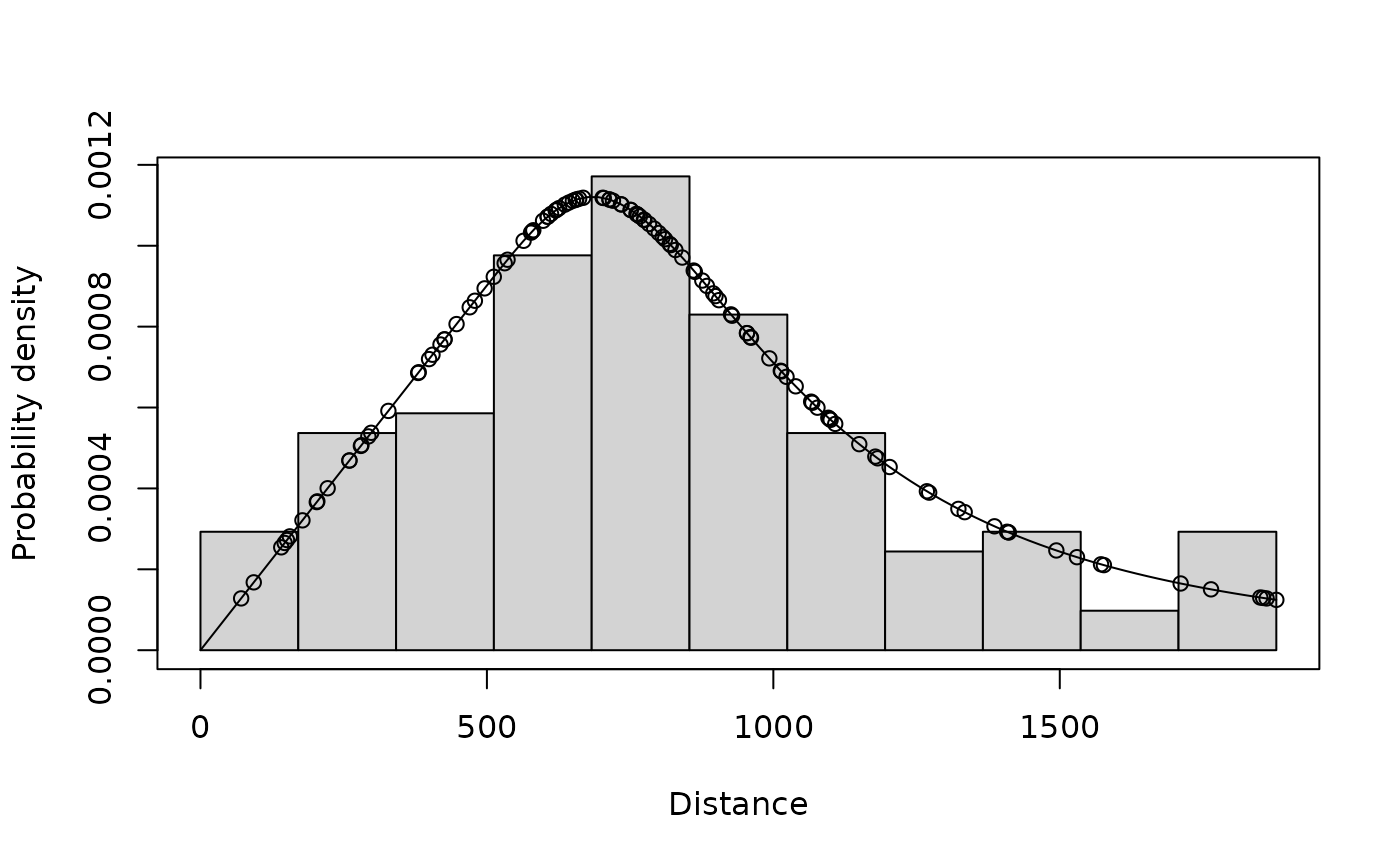
print(edr_from_distmodel(ds_model)) # in metres
#> [1] 1132.655
print(w_from_distmodel(ds_model)) # truncation distance / max distance in m
#> [1] 2334
Flight heights
prop_at_height is either a single value or distribution
information which represents the proportion of flights at rotor swept
height while prop_below_height is the proportion of flights
below rotor swept height.
In order to determine the flight flux we need an effective detection height, but unlike with the EDR we can’t fit a distance model to the heights because distance modelling relies on the assumption that the birds are uniformly distributed at all distances, which we know is not the case in vertical space (i.e. the density of flights tends to drop off with increasing height).
The simplest way to avoid biasing the estimate by artificially
inflating or deflating the flux through the turbine is to desktop
truncate1
the observations to the maximum tip height of the turbine and use that
as the effective detection height (all the observations can still be
used to fit the observer’s detection function since it is just used for
the horizontal distance correction). Other methods for estimating an
effective detection height can be used, but this method is the most
straightforward and will work well in almost all cases. In this example
(and in most cases) we are desktop truncating the observations to the
height of the turbine. So prop_at_height and
prop_below_height should sum to 1.
The proportion of flights at and below rotor swept height account for
the amount of flights at risk of being struck by the blades of the
turbine. We only need to calculate a distribution for
prop_below_height since
prop_at_height = 1 - prop_below_height.
A simple, single value example of this is given below.
# rotor_diam / 2 is better than using blade length because it
# includes the nacelle size
min_rsh <- v90_single$hh - v90_single$rotor_diam * 0.5
max_rsh <- v90_single$hh + v90_single$rotor_diam * 0.5

## Review the heights
ggplot(data = as.data.frame(df_obs),
       aes(x = height, y = after_stat(density))) +
  geom_histogram() +
  geom_vline(xintercept = min_rsh, colour = "red") +
  geom_vline(xintercept = max_rsh, colour = "red")
#> `stat_bin()` using `bins = 30`. Pick better value `binwidth`.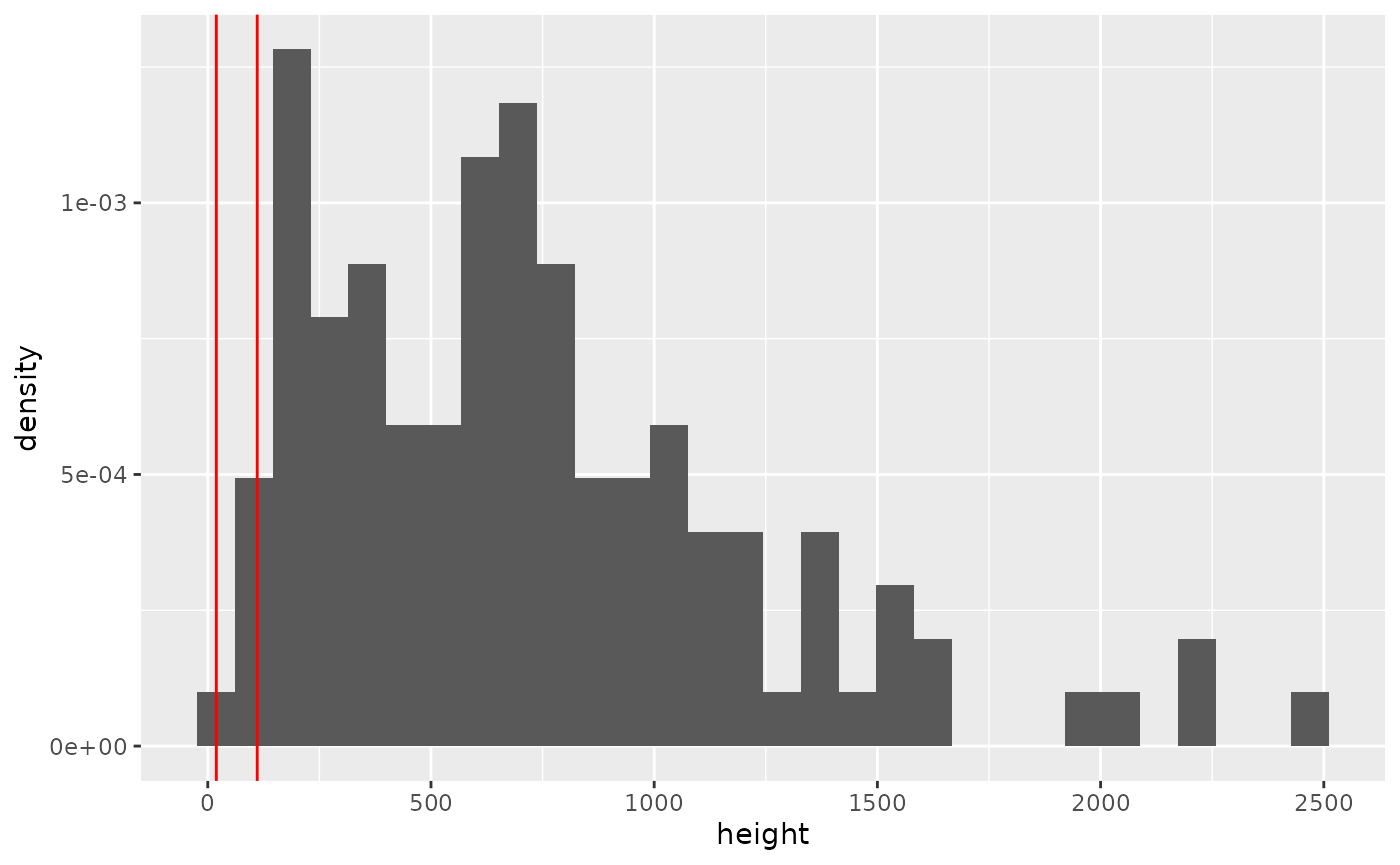
# calculate ecdf (empirical cumulative distribution function)
# Note - this is a simple example; it's up to the analyst how best to
## fit the height distribution
cdf_height <- ecdf(df_obs[df_obs$height <= max_rsh, "height"])

prop_below_height <- cdf_height(min_rsh)
prop_at_height <- 1 - prop_below_height- Proportion at height: 0.8139535
- Proportion below height: 0.1860465
Run the model
For a deterministic model, we need the following 4 steps:
- Step 1 - Run
encounter_rate()- calculate the uncorrected flights per survey minute. - Step 2 - Run
obs_flux(),turbine_flux()andflux_per_year()- calculate flux through turbine per year. This can also be done in one step usingturbine_flux_year(). - Step 3 - Run
prob_collision_static()andprob_collision_dynamic()- calculate for one interaction - Step 4 - Run
n_collisions()- calculate number of collisions a year
Step 1 - Encounter rate
This is where we determine the average encounter rate per unit time of survey. That is the average number of individuals observed in each minute of survey (or whatever unit of time you wish to use). This is basically just , however the function also allows for weighting surveys to account for stratification and can apply the Wilson correction (Wilson 1927) if there were no observations. The Wilson correction is an estimate of the hypothetical encounter rate (mid-point of the 95% CI) that could result in zero observations.
As discussed above, we are desktop truncating to the maximum rotor swept height of the turbine, so this encounter rate will be the encounter of birds at risk height.
This function takes as input a df_obs_summary
data.frame. This object has one row per survey and must contain a column
named survey_duration and a column named size
which is the total number of individuals observed below
the maximum turbine height (unless using another method to estimate
effective detection height) in each survey (not
observation). Optionally, it can contain a column named
survey_weight which has the associated relative weights of
each survey (to avoid artificially inflating or deflating the encounter
rate sum(survey_weight) must equal the number of
surveys).
First let’s make that table (using data.table):
dt_obs <- copy(df_obs)
dt_survey <- copy(df_survey)

setDT(dt_obs)
setDT(dt_survey)

dt_obs_survey <- dt_obs[height <= max_rsh, .("size" = sum(size)), survey_id
                        ][dt_survey,
                          on = "survey_id"]
# need sum(size) because we want one row per survey (not observation)
Now we can use this table in encounter_rate():
flights_per_min <- encounter_rate(
  df_obs_summary = dt_obs_survey,
  wilson_correction = TRUE # Default
 )
#> Warning in encounter_rate(df_obs_summary = dt_obs_survey, wilson_correction =
#> TRUE): NA observations detected - NA observation size will be assumed to be 0
Any surveys with NA observations are assumed to have
zero observations, which, if you left join to the survey table by
survey_id (like we did above), should be correct. The
average number of movements observed per minute of survey is 0.0248889
flights per minute.
Step 2 - Flux through turbine
This is where we account for
- The observer’s detection model (
eff_detection_widthobtained usingedr_dist_model()) - The size of the turbine (contained in the object made using
define_turbine()) - The turbine layout
- The proportion of the day active (contained in the object made using
define_bird()) - The proportion of the year active (contained in the object made
using
define_bird())
We first calculate the observed flux through a vertical airspace. This is in flights per unit time per unit area (assuming we are below max turbine height), in this example the units are minutes and metres squared, respectively.
Second we calculate the cluster correction factor (and any spatial flights pdf if you are doing a spatial model).
We then apply these to the “turbine plane” (a rectangular “doorway”
defined by the rotor diameter and maximum rotor swept height) using
turbine_flights() to obtain the flights through the turbine
plane per minute.
# flights / m / min
obs_flux_min <- obs_flux(
  encounter_rate = flights_per_min, # numeric per min
  eff_detection_width = 2.0*edr_from_distmodel(ds_model),
  eff_detection_height = max_rsh
)

effective_flux <- cluster_correction_a(
  eff_detection_width = 2*edr_from_distmodel(ds_model),
  df_turbines = df_turbines)

#flights through turbine / min

turbine_flights_min <- turbine_flights(
  obs_flux = obs_flux_min,
  spatial_correction = effective_flux,
  rotor_diameter  = v90_single$rotor_diam,
  hub_height = v90_single$hh
)
The observed flight flux is 9.9160323^{-8} flights per square meter per minute (below max turbine height). Scaling up to the turbine this corresponds to 7.7724725^{-4} flights through the turbine area per minute.
Here we correct it for daily and monthly variability. This can be done by hand but the package includes a helper function which can scale to a year.
turbine_flight_year <- flights_per_year(
  flights_per_time = turbine_flights_min,
  time_units = "min",
  prop_day = wte$prop_day, # diurnal
  prop_year = wte$prop_year # present all year
)- The units for
turbine_flight_yearis flights / year (per turbine). - We expect 204.400481 flights through the turbine area each year.
This is the expected number of interactions2 per turbine per year with no avoidance.
Step 3 - Probability of collision given interaction
This is the probability a given flight through the turbine window will collide, assuming no avoidance.
Our approach considers both the static () and dynamic components ()
Without avoidance, and isolated from the overall collision rate calculation, the total probability of collision, given interaction is the
because the two options are mutually exclusive.
Let’s calculate the collision probability for a Wedge-tailed Eagle and the V90 turbine model.
df_turbines$p_coll_static <- prob_collision_static(
  d_base = v90_single$d_base,
  d_rotormin = v90_single$d_rotormin,
  d_top = v90_single$d_top,
  hh = v90_single$hh,
  blade_length = v90_single$blade_length,
  max_nac_h = v90_single$max_nac_h,
  max_nac_l = v90_single$max_nac_l,
  max_width_nacelle = v90_single$max_width_nacelle,
  rotor_diam = v90_single$rotor_diam,
  tilt_deg = v90_single$tilt_deg,
  max_chord = v90_single$max_chord,
  min_chord = v90_single$min_chord,
  blade_thickness_wide = v90_single$blade_thickness_wide,
  blade_thickness_narrow = v90_single$blade_thickness_narrow,
  prop_at_height = prop_at_height,
  prop_below_height = prop_below_height
)

df_turbines$p_coll_dyn <- prob_collision_dynamic(
  rpm = v90_single$rpm,
  blade_length = v90_single$blade_length,
  max_width_nacelle = v90_single$max_width_nacelle,
  rotor_diam = v90_single$rotor_diam,
  blade_thickness_wide = v90_single$blade_thickness_wide,
  blade_thickness_narrow = v90_single$blade_thickness_narrow,
  hh = v90_single$hh,
  bird_length = wte$bird_length,
  bird_speed = wte$bird_speed,
  prop_at_height = prop_at_height,
  prop_below_height = prop_below_height,
  prop_operational = v90_single$prop_operational
)
Step 4 - Total annual collisions (with avoidance)
Now using the calculated yearly interactions (flights through the turbine area) and probability of collision given interaction as well as the expected avoidance rates, we can obtain an estimate of the total number of expected collision per year.
df_turbines$n_collision <- n_collision(
  avoidance_rate_static = wte$avoidance_static,
  avoidance_rate_dynamic = wte$avoidance_dynamic,
  n_flights = turbine_flight_year,
  p_coll_static = df_turbines$p_coll_static,
  p_coll_dynamic = df_turbines$p_coll_dyn
)

## For a final result, sum all turbines
sum(df_turbines$n_collision)
#> [1] 1.882086